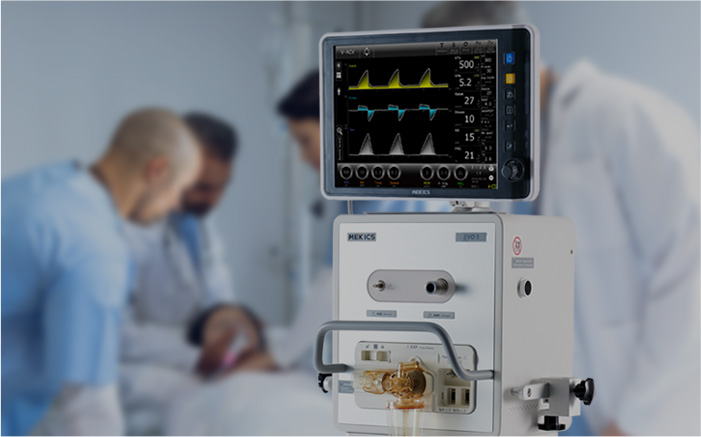
Comprehensive Ventilation Solutions

Non-disconnection solution for successful weaning

A single ventilator solution allows for switching between different ventilation modes and continuous treatment without interruption.
This continuous care prevents lung collapse and ventilator-associated pneumonia,
and facilitates the patient's stable recovery of spontaneous breathing and successful weaning.

Conventional
Ventilation Mode
Suction Support
CPAP RSBI P 0.1
O₂ Stream T-Piece Trial
O₂ Stream High Flow
Nasal Cannula
Closed Suction Support
  • Prevents asynchrony and PEEP reduction due to negative pressure during suction operation
  • The O₂ Booster is activated to supply additional oxygen for 2 minutes up to the set oxygen concentration.
O₂ Stream
  • Provides HFNC (O₂ Stream) and NIV (Spont+PSV & Leak Compensation) ventilation modes
  • Safely manage patients without additional device when a change in ventilation mode is required
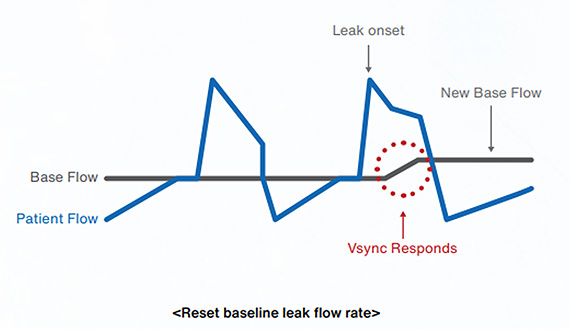
Smart leak compensation

Compensates for leaks up to 60 LPM, minimizing patient discomfort and maximizing treatment efficiency.
If an unexpectedly large leak occurs, the leak level is quickly assessed and compensated for within a single breath, minimizing patient asynchronization.
Furthermore, if PEEP is not maintained, it is immediately compensated for and synchronized with the patient's breathing within one or two breaths.

Advanced Monitoring Support

Precision monitoring capabilities allow for more in-depth analysis
of a patient's respiratory status and the development of personalized ventilation strategies.

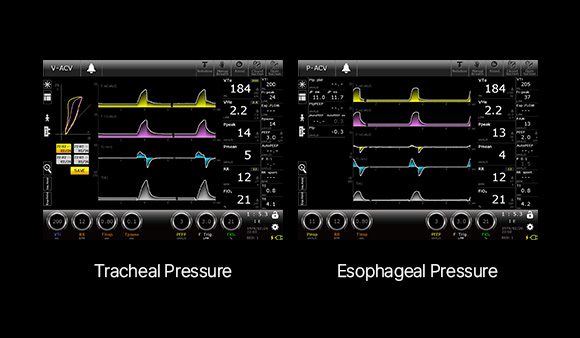
Esophageal / Tracheal Pressure

Esophageal indirectly measures intrathoracic pressure and allows
for the calculation of actual lung pressure (transpulmonary pressure).
This aids in more precise mechanical ventilation settings and lung
protection strategies (P-Lung Protection).

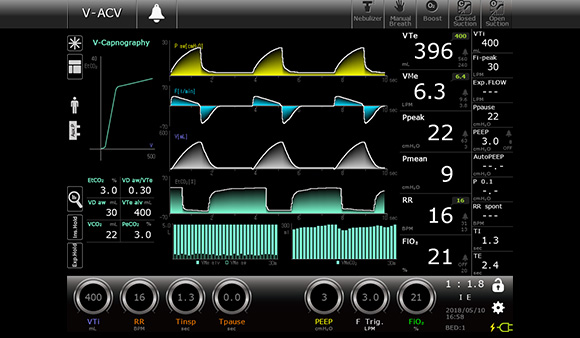
VCO2

Real-time VCO2 monitoring allows for precise assessment
of a patient's metabolic status and ventilation efficiency.
This is useful for developing quantitative ventilation strategies
in respiratory diseases, critical care patients, and other settings.

Reduce Ventilator-induced lung injury (VILI)
through HFOV(High Frequency Oscillated Ventilation)

  • The tube-piston design minimizes the risk of pressure damage.
  • Seamless transition from HFV to standard ventilation without replacing breathing kits
  • Provides high average flow rates and exceeds the patient's peak expiratory
    flow requirements, effectively supporting spontaneous breathing.

Easy, Safe & Comfort Care

SpO₂ & EtCO₂ measurements

  • Option to provide information on CO₂ and SpO₂, metabolic products, through ventilation
  • Reduces reliance on arterial blood gas analysis (ABGA) and provides medical professionals
    with useful information for patient care without the need for a separate patient monitoring system

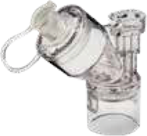
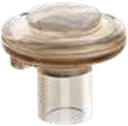
Two types of nebulization system

Two options available: Micropump and Pneumatic nebulizer

Single use
Micro-pump Nebulizer

Reusable
Micro-pump Nebulizer

Basic type

Pneumatic bebulizer
(medicine is delivered through air)

Optional type

Micropump bebulizer
(Vibration produces finer particles
that are more effectively absorbed by the patient)